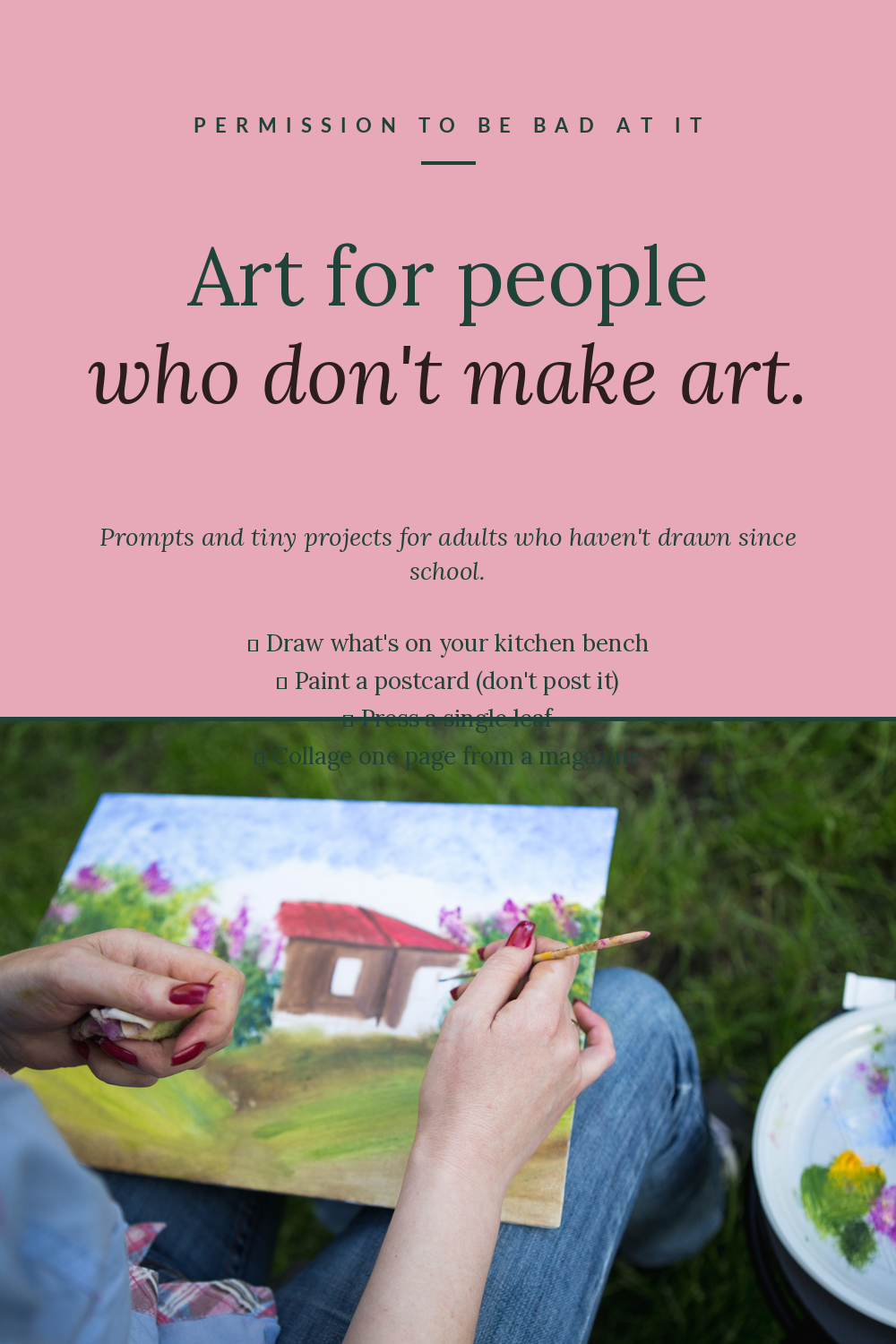
Art for People Who Don't Make Art (Permission to Be Bad At It)
Art for People Who Don't Make Art
I want to tell you about the moment I started drawing again at thirty-three.
I had just had a baby and I was tired in the specific way that being a new parent is tired, like my bones had taken on water. One Sunday afternoon I found an unused notebook in a kitchen drawer and a single black biro that was nearly out of ink, and I sat down at the kitchen table and drew the mug that was in front of me on the bench. The mug looked terrible in the drawing. It was lopsided, the handle was wrong, the shadow was nowhere. But for the eight minutes that I sat there drawing it I had thought about nothing else. Not the baby, not the laundry, not my phone, just the mug.
I have drawn, very badly, at least once a week ever since. That was eighteen months ago and I am still bad at it, in the most useful sense of the word.
This piece is for everyone who has been carrying around a small voice that says "I used to make things" and not done anything about it because of all the reasons we tell ourselves. Here is a list of tiny art projects, and none of them require skill, and none of them require anyone to see what you have made, and none of them have to become anything.
The four-word permission slip
Before any of what follows, hold these four words in your head while you read.
No one has to see it.
Genuinely. The notebook stays in a drawer. The painting stays on your wall behind a door in the room nobody goes into. You do not have to post it, you do not have to show your partner, you do not even have to keep it. You are allowed to throw it away the same evening you finished it. The doing is the entire thing.
1. Draw what is on your kitchen bench
Five or ten minutes, pencil or biro, any paper. Whatever is there in front of you. The mug, the fruit bowl, the peeler still sitting out from dinner, the cat sitting next to the toaster looking pleased with itself. Do not think about it too much. The point is not accuracy, the point is noticing. You will probably discover that you have been looking at your kitchen for ten years without ever actually seeing it.
2. Press a single leaf or flower in a book
The slowest and easiest art project there is. Find a flat-ish flower or leaf. Put it between two pieces of clean paper. Stick that inside a heavy book. Wait one month and forget about it. A month later, open the book carefully and the leaf is now art. Glue it onto a piece of cardstock and frame it, or tape it inside a letter to someone you love. This is, technically, how the Royal Botanic Gardens have collected specimens for two hundred years.
3. Paint a postcard and do not post it
Buy a small watercolour set from a bookshop for about fifteen dollars. Paint a postcard. The postcard does not have to depict a place. It can be a leaf, a face, a colour, a weather system, anything. One postcard. Keep it in a box on the shelf. Six months in you will have a small collection, and the first five will be terrible and the sixth will be passable and by the twentieth you will be a person who paints postcards.
4. Collage one magazine page
The least intimidating art project there is. Take an old magazine, rip out a page that has interesting colours or textures, cut out shapes with kitchen scissors, stick them onto another piece of paper, move them around until they please you, glue them down. This is the same activity adults pay forty dollars to do in "creative wellness workshops" in Mornington and you can do it on your kitchen table for the cost of a glue stick.
5. Draw your own family
Stick figures are completely fine. Each member of your family, household or dog, one per page. Caption each one with a single specific thing about them. "Tom, always loses his keys." "Sage the dog, believes she is a person and resents being told otherwise." You will have made a small heirloom. Five years from now you will find it in a drawer and weep slightly, in the good way.
6. The colour wheel exercise
Get any watercolours, paint a primary red, blue and yellow on a page, then mix them in pairs to discover how green and orange and purple actually come about. This is genuinely magical the first time you do it, and it took me thirty-three years to do it for the first time, and I wish I had done it sooner.
7. Draw the same thing every day for a week
Same mug, same window, same plant, one small drawing per day, pencil or biro, two minutes. By Sunday the drawings will have got noticeably better and you will have proof that you got better at something in seven days, which is rarer in adult life than you might think. You will also have a small visual record of your week. Day three was rainy, day five was sunny, day seven your hand was steadier than it had been on day one. The notebook becomes a journal that does not read like a journal.
8. Make a child the things you wish you had had
If you have small children in your life, make them little zines, little hand-stitched books, little notes hidden in their lunchboxes, drawings on the back of cereal boxes. Their art will improve over the years and so will yours. None of it has to be good and all of it will be remembered.
9. The slow art weekend
One Saturday a month, dedicate ninety minutes to one slightly bigger project. A small watercolour, a painted card that you actually do post this time, a page of pressed flowers carefully arranged, a hand-cut decoration for the front of a notebook. Ninety minutes a month is eighteen hours a year of you making art, which is more than most people you know are doing, and at the end of a year you will not be Matisse, but you will be a person who makes things.
Why this matters
The brain gets quiet when the hand is doing something specific. The phone cannot ask for your attention when one hand is holding a pencil and the other is steadying a page. There is no notification you can receive while you are mixing a colour from primary red and primary blue. The mug being drawn does not care whether anyone sees the drawing, and neither, it turns out, do you, once you have started.
That is the secret nobody told us when we stopped making art as teenagers. The audience does not actually matter. The hand and the paper and the eight minutes are the entire point.

The Offline Box includes a small art project every month with an original print and a prompt to make something using whatever is around the house. No skill required. Founding fifty for June, a handful left.
With love, Sam